google chrome os can t open this page
 Logo as of July 2020 | |
 Chrome OS 87 Desktop | |
| Developer | |
|---|---|
| Written in | C, C++, assembly, JavaScript, HTML5, Python, Rust |
| Bone family | Linux (Unix-similar)[1] |
| Working state | Preinstalled on Chromebooks, Chromeboxes, Chromebits, Chromebases, Chromeblets |
| Source model | Closed-source with open-source components |
| Initial release | June xv, 2011 (2011-06-15) |
| Latest release | 97.0.4692.91 (January 18, 2022 (2022-01-18) [2]) [±] |
| Latest preview |
98.0.4758.67 (January 25, 2022 (2022-01-25) [3]) [±]
|
| Update method | Rolling release |
| Package managing director | Portage[a] |
| Platforms | ARM32, ARM64, x86, x86-64 |
| Kernel type | Monolithic (Linux kernel)[6] |
| Userland | Aura Shell (Ash), Ozone (display manager); X11 apps can be enabled in contempo Chrome OS |
| Default user interface | Google Chrome |
| License | Proprietary[vii] |
| Official website | world wide web |
Chrome OS (sometimes styled as chromeOS) is a Gentoo Linux-based operating system designed by Google. It is derived from the free software Chromium Os and uses the Google Chrome spider web browser as its primary user interface. Unlike Chromium OS, Chrome Os is proprietary software.
Google announced the projection, based on Ubuntu,[viii] in July 2009, conceiving it as an operating system in which both applications and user data reside in the deject: hence Chrome Bone primarily runs web applications.[9] Source lawmaking and a public demo came that November. The beginning Chrome OS laptop, known every bit a Chromebook, arrived in May 2011. Initial Chromebook shipments from Samsung and Acer occurred in July 2011.
Chrome Os has an integrated media player and file manager. Information technology supports Progressive Web Apps and Chrome Apps; these resemble native applications, as well equally remote admission to the desktop. Every bit more Chrome Os machines have entered the marketplace, the operating system is now seldom evaluated apart from the hardware that runs it.[ten]
Android applications started to get available for the operating arrangement in 2014, and in 2016, access to Android apps in Google Play'south entirety was introduced on supported Chrome OS devices. Support for a Linux last and applications, known as Project Crostini,[11] was released to the stable channel in 2018 with Chrome OS 69. This was made possible via a lightweight Linux kernel that runs containers inside a virtual motorcar.
Chrome Bone is only available pre-installed on hardware from Google manufacturing partners, but there are unofficial methods that permit information technology to be installed on other equipment.[12] Its open up-source upstream, Chromium OS, can exist compiled from downloaded source code. Early on, Google provided design goals for Chrome Os, but has not otherwise released a technical clarification.
History [edit]
Google announced Chrome OS on July 7, 2009,[1] describing it equally an operating system in which both applications and user data reside in the cloud. To ascertain marketing requirements, the company relied on informal metrics, including monitoring the usage patterns of some 200 Chrome OS machines used past Google employees. Developers too noted their own usage patterns. Matthew Papakipos, the former[13] engineering director for the Chrome Bone project, put three machines in his firm and institute himself logging in for brief sessions: to brand a unmarried search query or transport a short email.[14]
The initial builds of Chrome Os were based on Ubuntu, and its programmer, Canonical, was an engineer partner with Google on the projection. In 2010, Chrome Os moved to Gentoo Linux as its base to simplify its build procedure and support a variety of platforms. Sometime in 2013, Google switched Chrome Bone to its own flavour of Linux.[viii]
Chrome OS was initially intended for secondary devices similar netbooks, not as a user's master PC.[15] [16] While Chrome OS supports hard disk drives, Google has requested that its hardware partners use solid-state drives "for performance and reliability reasons"[17] as well as the lower capacity requirements inherent in an operating system that accesses applications and most user data on remote servers. In Nov 2009 Matthew Papakipos, engineering managing director for the Chrome OS, claimed that the Chrome OS consumes 1-sixtieth as much drive space as Windows seven.[18] The recovery images Google provides for Chrome Bone range between 1 and 3 GB.[nineteen]
On November 19, 2009, Google released Chrome OS's source code equally the Chromium Bone project.[20] At a November nineteen, 2009, news conference, Sundar Pichai, at the fourth dimension Google's vice president overseeing Chrome, demonstrated an early on version of the operating organization. He previewed a desktop which looked very similar to the Chrome browser, and in addition to the regular browser tabs, too had application tabs, which take less space and can be pinned for easier access. At the conference, the operating system booted up in 7 seconds, a time Google said it would piece of work to reduce.[17] [15] [21] [22] Additionally, Chris Kenyon, vice president of OEM services at Approved Ltd, announced that Canonical was under contract to contribute engineering resources to the project with the intent to build on existing open-source components and tools where viable.[23]
Early on Chromebooks [edit]
In 2010, Google released the unbranded Cr-48 Chromebook in a pilot plan.[24] [25] The launch date for retail hardware featuring Chrome OS was delayed from late 2010[26] until the next twelvemonth. On May 11, 2011, Google announced ii Chromebooks from Acer and Samsung at Google I/O.[27] [28] The Samsung model was released on June 15, 2011, but the Acer was delayed until mid-July.[29] [30] In Baronial 2011, Netflix announced official support for Chrome Bone through its streaming service, allowing Chromebooks to watch streaming movies and TV shows via Netflix. At the time, other devices had to use Microsoft Silverlight to play videos from Netflix.[31] Afterwards in that aforementioned month, Citrix released a customer application for Chrome Bone, allowing Chromebooks to access Windows applications and desktops remotely.[32] Dublin Metropolis University became the showtime educational institution in Europe to provide Chromebooks for its students when it announced an understanding with Google in September 2011.[33]
Expansion [edit]
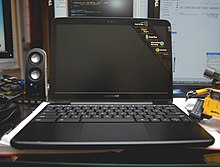
By 2012, need for Chromebooks had begun to grow, and Google announced a new range of devices, designed and manufactured by Samsung. In so doing, they also released the first Chromebox, the Samsung Series three, which was Chrome Bone's entrance into the world of desktop computers.[34] Although they were faster than the previous range of devices, they were even so underpowered compared to other desktops and laptops of the time, plumbing fixtures in more closely with the Netbook market. Only months later, in October, Samsung and Google released a new Chromebook at a significantly lower cost bespeak ($250, compared to the previous Serial 5 Chromebooks' $450).[35] Information technology was the get-go Chromebook to use an ARM processor, one from Samsung'south Exynos line. In lodge to reduce the price, Google and Samsung also reduced the memory and screen resolution of the device. An reward of using the ARM processor, however, was that the Chromebook didn't require a fan. Acer followed quickly afterwards with the C7 Chromebook, priced fifty-fifty lower ($199), but containing an Intel Celeron processor.[36] One notable fashion Acer reduced the cost of the C7 was to use a laptop difficult disk rather than a solid-country bulldoze.
In April 2012, Google made the first update to Chrome Bone's user interface since the operating arrangement had launched, introducing a hardware-accelerated window managing director called "Aureola" forth with a conventional taskbar. The additions marked a departure from the operating organisation'south original concept of a single browser with tabs and gave Chrome Os the look and feel of a more conventional desktop operating organisation. "In a way, this most feels as if Google is admitting defeat here", wrote Frederic Lardinois on TechCrunch. He argued that Google had traded its original version of simplicity for greater functionality. "That'southward not necessarily a bad matter, though, and may just assistance Chrome Os gain more than mainstream acceptance as new users volition surely find information technology to exist a more familiar experience."[37] Lenovo and HP followed Samsung and Acer in manufacturing Chromebooks in early 2013 with their ain models.[38] Lenovo specifically targeted their Chromebook at students, headlining their press release with "Lenovo Introduces Rugged ThinkPad Chromebook for Schools".[39] [forty]
When Google released Google Drive, they also included Drive integration in Chrome Os version xx, released in July 2012.[41] While Chrome Bone had supported Wink since 2010,[42] past the end of 2012 it had been fully sandboxed, preventing issues with Flash from affecting other parts of Chrome OS.[43] This afflicted all versions of Chrome including Chrome OS.
Chromebook Pixel [edit]

Chromebook Pixel (Wi-Fi) open up
Upwardly to this indicate, Google had never fabricated their own Chrome OS device. Instead, Chrome Os devices were much more similar to their Nexus line of Android phones, with each Chrome OS device being designed, manufactured, and marketed by third-party manufacturers, only with Google controlling the software. However, in February 2013 this changed when Google released the Chromebook Pixel.[44] The Chromebook Pixel was a divergence from previous devices. Not only was it entirely Google-branded, but it contained an Intel i5 processor, a high-resolution (2,560 × one,700) touchscreen brandish, and came at a toll more than competitive with business laptops.[45]
Controversial popularity [edit]
By the stop of 2013, analysts were undecided on the future of Chrome OS. Although there had been articles predicting the demise of Chrome Bone since 2009,[46] [47] [48] [49] [l] Chrome Bone device sales connected to increase substantially year-over-year. In mid-2014, Time magazine published an article titled "Depending on Who'southward Counting, Chromebooks are Either an Enormous Hit or Totally Irrelevant", which detailed the differences in opinion.[51] This controversy was farther spurred by the fact that Intel seemed to decide Chrome Bone was a beneficial market for it, holding their own Chrome Os events where they announced new Intel-based Chromebooks, Chromeboxes, and an all-in-one from LG called the Chromebase.[52]
Seizing the opportunity created by the terminate of life for Windows XP, Google pushed hard to sell Chromebooks to businesses, offer significant discounts in early on 2014.[53]
Chrome Bone devices outsold Apple Macs worldwide for the year 2020.[54] [55] [56]
Pwnium competition [edit]
In March 2014, Google hosted a hacking contest aimed at computer security experts called "Pwnium". Like to the Pwn2Own contest, they invited hackers from around the globe to find exploits in Chrome Bone, with prizes available for attacks. 2 exploits were demonstrated there, and a tertiary was demonstrated at that year's Pwn2Own competition. Google patched the issues inside a week.[57]
Cloth Design and app runtime for Chrome [edit]
Although the Google Native Client has been available on Chrome OS since 2010,[58] at that place originally were few Native Client apps available, and virtually Chrome Bone apps were still web apps. However, in June 2014, Google appear at Google I/O that Chrome OS would both synchronise with Android phones to share notifications and begin to run Android apps, installed directly from Google Play.[59] This, forth with the broadening selection of Chromebooks,[60] provided an interesting futurity for Chrome OS.
At the aforementioned fourth dimension, Google was also moving towards the and so-new Material Pattern pattern language for its products, which it would bring to its web products likewise every bit Android Lollipop.[61] One of the kickoff Fabric Design items to come to Chrome Os was a new default wallpaper,[62] though Google did release some screenshots of a Fabric Pattern experiment for Chrome OS that never fabricated it into the stable version.[63]
Functionality for small and medium businesses and Enterprise [edit]
Chrome Enterprise [edit]
Chrome Enterprise, launched in 2017, includes Chrome OS, Chrome Browser, Chrome devices and their management capabilities intended for business use. Businesses can access the standard Chrome OS features and unlock advanced features for business concern with the Chrome Enterprise Upgrade.[64] [65] Standard features include the ability to sync bookmarks and browser extensions across devices, cloud or native printing, multi-layered security, remote desktop, and automated updates.[66] Advanced features include Active Directory integration, unified endpoint direction, advanced security protection, access to device policies and Google Admin console, guest admission, kiosk fashion, and whitelisting or blacklisting third-party apps managed on Google Play.[67] [68]
The instruction sector was an early adopter of Chromebooks, Chrome OS, and deject-based computing. Chromebooks are widely used in classrooms and the advantages of cloud-based systems have been gaining an increased share of the market in other sectors besides, including financial services, healthcare and retail.[69] "The popularity of deject computing and cloud-based services highlights the degree to which companies and business processes take become both cyberspace-enabled and dependent."[lxx] IT managers cite a number of advantages of the cloud that take motivated the movement. Among them are avant-garde security, because data is non physically on a single motorcar that tin be lost or stolen.[71] Deploying and managing deject-native devices is easier because no hardware and software upgrades or virus definition updates are needed and patching of Bone and software updates are simpler. Simplified and centralized management decreases operational costs.
Employees tin can securely admission files and work on whatever machine, increasing the shareability of Chrome devices. Google'south Catch and Get program with Chrome Enterprise allows businesses deploying Chromebooks to provide employees access to a banking company of fully charged computers that can be checked out and returned subsequently a menstruum of time.[72]
From Chromebooks to Chromebox and Chromebase [edit]
In an early endeavour to expand its enterprise offerings, Google released Chromebox for Meetings in February 2014. Chromebox for Meetings is a kit for briefing rooms containing a Chromebox, a camera, a unit containing both a racket-cancelling microphone and speakers, and a remote control. It supports Google Hangouts meetings, Vidyo video conferences, and conference calls from UberConference.[73] [74]
Several partners announced Chromebox for Meetings models with Google, and in 2016 Google appear an all-in-one Chromebase for Meetings for smaller meeting rooms.[75] Google targeted the consumer hardware market place with the release of the Chromebook in 2011 and Chromebook Pixel in 2013, and sought access to the enterprise market with the 2017 release of the Pixelbook. The second-generation Pixelbook was released in 2019.[76] In 2021 in that location are several vendors selling all-in-one Chromebase devices.[77]
Enterprise response to Chrome devices [edit]
Google has partnered on Chrome devices with several leading OEMs, including Acer, ASUS, Dell, HP, Lenovo, and Samsung.
In August 2019, Dell announced that two of its popular business-focused laptops would run Chrome Os and come with Chrome Enterprise Upgrade. The Latitude 5300 2-in-1 Chromebook Enterprise and Latitude 5400 Chromebook Enterprise were the result of a two-year partnership betwixt Dell and Google.[78] The machines come with a bundle of Dell's cloud-based back up services that would enable enterprise Information technology managers to deploy them in environments that also rely on Windows.[79] The new laptop line "delivers the search giant's Chrome OS operating organization in a course tailored for security-witting organizations."[80] Other OEMs that accept launched devices with Chrome Enterprise Upgrade include Acer and HP.[81]
With a broader range of hardware available, Chrome OS became an pick for enterprises wishing to avoid a migration to Windows 10 before Windows vii support was discontinued by Microsoft.[82]
Hardware [edit]

Laptops running Chrome Os are known collectively as "Chromebooks". The kickoff was the CR-48, a reference hardware design that Google gave to testers and reviewers beginning in Dec 2010. Retail machines followed in May 2011. A year later, in May 2012, a desktop pattern marketed as a "Chromebox" was released past Samsung. In March 2015 a partnership with AOPEN was announced and the first commercial Chromebox was adult.[83]
In early on 2014, LG Electronics introduced the first device belonging to the new all-in-one class factor called "Chromebase". Chromebase devices are essentially Chromebox hardware inside a monitor with a built-in camera, microphone and speakers.
The Chromebit is an HDMI dongle running Chrome OS. When placed in an HDMI slot on a television receiver ready or computer monitor, the device turns that display into a personal computer. The outset device, announced in March 2015 was an Asus unit of measurement that shipped that November and which reached end of life in November 2020.[84]
Chromebook tablets were introduced in March 2018 by Acer with their Chromebook Tab 10. Designed to rival the Apple iPad, it had an identical screen size and resolution and other similar specifications, a notable add-on was a Wacom-branded stylus that doesn't require a battery or charging.[85]
Chrome OS supports multi-monitor setups, on devices with a video-out port, USB 3.0 or USB-C, the latter being preferable.[86]
Software [edit]
The software and updates are limited in their back up lifetime.[87] [88] Each device model manufactured to run Chrome Bone has a different stop-of-life date, with all new devices released in 2020 and across guaranteed to receive a minimum of viii years from their engagement of initial release.[89]
As of Version 78, the device's end-of-life date for software updates is listed in "Virtually Chrome OS"-"Additional Details".[ninety]
Applications [edit]
Initially, Chrome OS was almost a pure web sparse client operating arrangement that relied primarily on servers to host web applications and related data storage.[91] [92] Google gradually began encouraging developers to create "packaged applications", and later, Chrome Apps. The latter employ HTML5, CSS, Adobe Shockwave, and JavaScript to provide a user experience closer to a native application.[93] [94]
In September 2014, Google launched App Runtime for Chrome (beta), which immune certain ported[95] Android applications to run on Chrome OS. Runtime was launched with four Android applications: Duolingo, Evernote, Sight Words, and Vine.[96] In 2016, Google fabricated Google Play bachelor for Chrome OS, making most Android apps available for supported Chrome OS devices.[97]
In 2018, Google announced plans for Chrome OS support for desktop Linux apps.[98] This capability was released to the stable channel (every bit an option for most machines) with Chrome 69 in October 2018, simply was all the same marked as beta.[99] This feature was officially released with Chrome 91.[100]
Past default X11 is non used,[101] [ ameliorate source needed ] while X11 apps can exist run.[102] [ meliorate source needed ] Project Crostini makes X11 work (through Wayland).[103]
Chrome Apps [edit]
From 2013 until Jan 2020, Google encouraged developers to build not but conventional Web applications for Chrome OS, merely Chrome Apps (formerly known every bit Packaged Apps).[104] In January 2020, Google's Chrome team appear its intent to stage out back up for Chrome Apps in favor of "progressive web applications" (PWA) and Chrome extensions instead.[105] In March 2020, Google stopped accepting new public Chrome Apps for the web store.[106] Co-ordinate to Google, full general support for Chrome Apps on Chrome OS will remain enabled, without requiring any policy setting, through June 2022.[106]
From a user'southward perspective, Chrome Apps resemble conventional native applications: they tin be launched outside of the Chrome browser, are offline past default, can manage multiple windows, and collaborate with other applications. Technologies employed include HTML5, JavaScript, and CSS.[107] [108] [109]
Integrated media player, file manager [edit]
Google integrates a media actor into both Chrome OS and the Chrome browser, enabling users to play back MP3s, view JPEGs, and handle other multimedia files while offline.[110] It as well supports DRM videos.[111]
Chrome Bone also includes an integrated file manager, resembling those found on other operating systems, with the ability to display directories and the files they contain from both Google Drive and local storage, likewise as to preview and manage file contents using a variety of Web applications, including Google Docs and Box.[112] Since January 2015, Chrome Os can also integrate additional storage sources into the file manager, relying on installed extensions that use the File Arrangement Provider API.[113]
Remote awarding access and virtual desktop admission [edit]
In June 2010, Google software engineer Gary Kačmarčík wrote that Chrome OS would admission remote applications through a engineering science unofficially called "Chromoting", which would resemble Microsoft'southward Remote Desktop Connection.[110] The proper noun has since been changed to "Chrome Remote Desktop", and is like "running an application via Remote Desktop Services or by first connecting to a host car past using RDP or VNC".[114] Initial curl-outs of Chrome OS laptops (Chromebooks) indicate an involvement in enabling users to access virtual desktops.[115] [116]
Android applications [edit]
At Google I/O 2014, a proof of concept showing Android applications, including Flipboard, running on Chrome OS was presented. In September 2014, Google introduced a beta version of the App Runtime for Chrome (ARC), which allows selected Android applications to be used on Chrome OS, using a Native Client-based environment that provides the platforms necessary to run Android software. Android applications practise not require any modifications to run on Chrome Os, only may exist modified to improve support a mouse and keyboard surroundings. At its introduction, Chrome OS support was just available for selected Android applications.[117]
In 2016, Google introduced the power to run Android apps on supported Chrome Os devices, with access to Google Play in its entirety. The previous Native Client-based solution was dropped in favor of a container containing Android'due south frameworks and dependencies (initially based on Android Marshmallow), which allows Android apps to have direct access to the Chrome OS platform, and let the Bone to interact with Android contracts such as sharing. Engineering director Zelidrag Hornung explained that ARC had been scrapped due to its limitations, including its incompatibility with the Android Native Development Toolkit (NDK), and that it was unable to pass Google'due south ain compatibility examination suite.[118] [119]
Linux apps [edit]
All Chromebooks since 2018 and many before models can run full-fledged Linux apps; equally with Android apps, they tin can be installed and launched alongside other apps.[120] Google maintains a listing of devices that were launched before 2019, which support Linux apps.[121] [122]
Since 2013, it has been possible to run Linux applications in Chrome Bone through the use of Crouton, a tertiary-party set of scripts that allows access to a Linux distribution such every bit Ubuntu.[123] Notwithstanding, in 2018 Google announced that desktop Linux apps were officially coming to Chrome OS.[124] The main benefit claimed by Google of their official Linux application back up is that it tin can run without enabling programmer mode, keeping many of the security features of Chrome Os. It was noticed in the Chromium OS source code in early 2018.[125] [126] Early parts of Crostini were made bachelor for the Google Pixelbook via the dev aqueduct in February 2018 equally part of Chrome OS version 66,[127] [128] and information technology was enabled by default via the beta channel for testing on a variety of Chromebooks in August 2018 with version 69.[129]
Architecture [edit]
Google's project for supporting Linux applications in Chrome Bone is called Crostini, named for the Italian breadstuff-based starter, and every bit a pun on Crouton. Crostini runs a virtual machine through a virtual machine monitor chosen crosvm, which uses Linux's built-in KVM virtualization tool. Although crosvm supports multiple virtual machines, the one used for running Linux apps, Termina, contains a basic Chrome Os kernel and userland utilities, in which it runs containers based on Linux containers (specifically LXD).[11]
Windows apps [edit]
In belatedly 2020, Parallels launched Parallels Desktop for Chrome OS, which allows Windows 10 virtual machines to exist run on Chromebook Enterprise devices.[130]
Architecture [edit]
Chrome OS is built on superlative of the Linux kernel. Originally based on Ubuntu, its base was changed to Gentoo Linux in February 2010.[131] For Project Crostini, as of Chrome OS lxxx, Debian 10 (Buster) is used.[132] In preliminary design documents for the Chromium Bone open-source project, Google described a three-tier architecture: firmware, browser and window manager, and arrangement-level software and userland services.[133]
- The firmware contributes to fast boot fourth dimension by not probing for hardware, such as floppy disk drives, that are no longer mutual on computers, especially netbooks. The firmware also contributes to security by verifying each footstep in the kicking process and incorporating organization recovery.[133]
- System-level software includes the Linux kernel that has been patched to meliorate boot performance. Userland software has been trimmed to essentials, with management past Upstart, which can launch services in parallel, re-spawn crashed jobs, and defer services in the interest of faster booting.[133]
- The window manager handles user interaction with multiple client windows (much like other X window managers).[133]
Security [edit]
In March 2010, Google software security engineer Will Drewry discussed Chrome Bone security. Drewry described Chrome OS as a "hardened" operating system featuring auto-updating and sandbox features that would reduce malware exposure. He said that Chrome OS netbooks would be shipped with Trusted Platform Module (TPM), and include both a "trusted bootpath" and a physical switch under the battery compartment that activates a "developer mode". That mode drops some specialized security functions but increases developer flexibility. Drewry too emphasized that the open-source nature of the operating arrangement would contribute greatly to its security past assuasive constant developer feedback.[134]
At a December 2010 press briefing, Google declared that Chrome Os would be the most secure consumer operating arrangement due in part to a verified boot power, in which the initial boot code, stored in read-only memory, checks for system compromises.[135] In the following nine years, Chrome Os has been affected by 55 documented security flaws of any severity,[136] compared with over 1,100 affecting Microsoft Windows x in the 5 years to the finish of 2019[137] and over ii,200 affecting Apple Os X in xx years.[138]
Shell access [edit]
Chrome Bone includes the Chrome Beat out, or "crosh",[139] which documents minimal functionality such as ping at crosh start-up.
In developer mode, a full-featured bash[140] shell (which is supposed to be used for development purposes[141]) tin exist opened via VT-ii, and is also accessible using the crosh command shell.[142] To access full privileges in beat out (e.g. sudo) a root password is requested. For some fourth dimension the default was "chronos" in Chrome Bone and "facepunch" in Chrome Os Vanilla[143] and afterwards the default was empty, and instructions on updating it were displayed at each login.
Open source [edit]
Chrome OS is partially adult under the open-source Chromium Bone projection.[144] As with other open-source projects, developers can modify the code from Chromium Bone and build their own versions, whereas Chrome OS code is only supported by Google and its partners and only runs on hardware designed for the purpose. Different Chromium Os, Chrome OS is automatically updated to the latest version.[17]
Chrome OS on Windows [edit]
On Windows 8, exceptions allow the default desktop web browser to offer a variant that can run within its total-screen "Metro" shell and access features such as the Share amuse, without necessarily needing to be written with Windows Runtime. Chrome's "Windows viii manner" was previously a tablet-optimized version of the standard Chrome interface. In October 2013, the mode was changed on Programmer channel to offering a variant of the Chrome OS desktop.[145] [146] [147] [148] [149]
Design [edit]
Early on in the project, Google provided publicly many details of Chrome OS's pattern goals and direction,[150] although the company has not followed upwardly with a technical description of the completed operating system.
User interface [edit]
Design goals for Chrome OS's user interface included using minimal screen infinite by combining applications and standard Web pages into a single tab strip, rather than separating the 2. Designers considered a reduced window management scheme that would operate only in full-screen fashion. Secondary tasks would be handled with "panels": floating windows that dock to the bottom of the screen for tasks like chat and music players. Separate screens were also under consideration for viewing 2 pieces of content adjacent. Chrome Bone would follow the Chrome browser'due south practice of leveraging HTML5's offline modes, groundwork processing, and notifications. Designers proposed using search and pinned tabs equally a way to quickly locate and access applications.[151]
Version xix window manager and graphics engine [edit]
On April 10, 2012, a new build of Chrome Os offered a selection betwixt the original total-screen window interface and overlapping, re-sizable windows, such as constitute on Microsoft Windows and Apple tree's macOS.[152] The feature was implemented through the Ash window manager, which runs atop the Aureola hardware-accelerated graphics engine. The April 2012 upgrade besides included the power to display smaller, overlapping browser windows, each with its own translucent tabs, browser tabs that tin exist "torn" and dragged to new positions or merged with another tab strip, and a mouse-enabled shortcut list beyond the bottom of the screen. One icon on the chore bar shows a list of installed applications and bookmarks. Writing in CNET, Stephen Shankland argued that with overlapping windows, "Google is anchoring itself into the past" as both iOS and Microsoft's Metro interface are largely or entirely full-screen. Nevertheless, "Chrome Bone already is unlike enough that information technology'due south all-time to preserve any familiarity that tin be preserved".[152] [153] [154]
Printing [edit]
Google Deject Impress is a Google service that helps whatsoever application on any device to print on supported printers. While the cloud provides virtually any connected device with information access, the task of "developing and maintaining print subsystems for every combination of hardware and operating system—from desktops to netbooks to mobile devices—simply isn't viable."[155] [156] The cloud service requires installation of a piece of software chosen proxy, equally part of the Chrome Os. The proxy registers the printer with the service, manages the print jobs, provides the printer driver functionality, and gives status alerts for each job.[157]
In 2016, Google included "Native CUPS Back up" in Chrome Os as an experimental characteristic that may eventually go an official characteristic. With CUPS support turned on, it becomes possible to use about USB printers even if they do not support Google Deject Print.[158] [159]
Google appear that Google Cloud Impress would no longer be supported subsequently December 31, 2020 and that the online service would not be available every bit of January 1, 2021.[160]
Link handling [edit]
Chrome OS was designed with the intention of storing user documents and files on remote servers. Both Chrome OS and the Chrome browser may innovate difficulties to cease users when treatment specific file types offline; for example, when opening an image or document residing on a local storage device, information technology may exist unclear whether and which specific Web application should exist automatically opened for viewing, or the handling should be performed by a traditional application acting as a preview utility. Matthew Papakipos, Chrome Bone engineering director, noted in 2010 that Windows developers have faced the same fundamental problem: "Quicktime is fighting with Windows Media Actor, which is fighting with Chrome."[14]
Release channels and updates [edit]
Chrome Bone uses the same release system as Google Chrome: there are three distinct channels: Stable, Beta, and Developer preview (called the "Dev" channel). The stable aqueduct is updated with features and fixes that take been thoroughly tested in the Beta channel, and the Beta aqueduct is updated approximately once a month with stable and consummate features from the Developer channel. New ideas get tested in the Developer channel, which can be very unstable at times.[161] [162] A fourth canary channel was confirmed to be by Google Programmer Francois Beaufort and hacker Kenny Strawn, by inbound the Chrome OS trounce in developer mode, typing the command trounce to access the bash shell, and finally inbound the command update_engine_client -channel canary-channel -update. It is possible to render to the verified boot mode afterwards entering the canary channel, but the channel updater disappears and the only way to return to another channel is using the "powerwash" factory reset.[163]
Reception [edit]
At its debut, Chrome Bone was viewed as a competitor to Microsoft, both directly to Microsoft Windows and indirectly the visitor'due south word processing and spreadsheet applications—the latter through Chrome OS's reliance on deject calculating.[164] [165] Simply Chrome OS engineering managing director Matthew Papakipos argued that the two operating systems would non fully overlap in functionality because Chrome Bone is intended for netbooks, which lack the computational power to run a resource-intensive program similar Adobe Photoshop.[14]
Some observers claimed that other operating systems already filled the niche that Chrome OS was aiming for, with the added advantage of supporting native applications in add-on to a browser. Tony Bradley of PC Earth wrote in November 2009:
We can already do virtually, if not all, of what Chrome Os promises to deliver. Using a Windows 7 or Linux-based netbook, users tin can simply not install annihilation merely a spider web browser and connect to the vast array of Google products and other spider web-based services and applications. Netbooks have been successful at capturing the low-terminate PC market place, and they provide a web-axial computing experience today. I am not sure why we should get excited that a year from now nosotros'll be able to practice the same thing, but locked into doing it from the fourth-identify web browser.[166]
In 2016, Chromebooks were the virtually pop reckoner in the US K–12 didactics market.[167]
By 2017, the Chrome browser had risen to become the number one browser used worldwide.[168]
In 2020, Chromebooks became the second most-popular cease-user oriented OS (growing from 6.four% in 2019 to 10.8% in 2020). The majority of growth came at Windows expense (which fell from 85.4% in 2019 to 80.5% in 2021).[169]
Relationship to Android [edit]
Google's offering of 2 open-source operating systems, Android[170] and Chrome OS, has drawn some criticism despite the similarity between this state of affairs and that of Apple Inc.'south two operating systems, macOS and iOS. Steve Ballmer, Microsoft CEO at the fourth dimension, defendant Google of not beingness able to make up its mind.[171] Steven Levy wrote that "the dissonance between the ii systems was apparent" at Google I/O 2011. The outcome featured a daily press conference in which each team leader, Android's Andy Rubin and Chrome's Sundar Pichai, "unconvincingly tried to explicate why the systems weren't competitive".[172] Google co-founder Sergey Brin addressed the question by saying that owning two promising operating systems was "a problem that near companies would love to face".[172] Brin suggested that the two operating systems "will probable converge over fourth dimension".[173] The speculation over convergence increased in March 2013 when Chrome OS chief Pichai replaced Rubin as the senior vice president in accuse of Android, thereby putting Pichai in accuse of both.[174]
The relationship between Android and Chrome OS became more substantial at Google I/O 2014, where developers demonstrated native Android software running on Chrome Bone through a Native Client-based runtime.[117] [175] In September 2014, Google introduced a beta version of the App Runtime for Chrome (ARC), which allows selected Android applications to be used on Chrome Os, using a Native Client-based surroundings that provides the platforms necessary to run Android software. Android applications practice not require whatever modifications to run on Chrome Os, but may exist modified to better support a mouse and keyboard environs. At its introduction, Chrome OS support was simply available for selected Android applications.[117] In October 2015, The Wall Street Journal reported that Chrome OS would be folded into Android so that a single OS would consequence past 2017. The resulting Bone would exist Android, merely it would be expanded to run on laptops.[176] [177] Google responded that while the visitor has "been working on ways to bring together the best of both operating systems, in that location'southward no programme to phase out Chrome OS".[178]
In 2016, Google introduced the ability to run Android apps on supported Chrome OS devices, with access to Google Play in its entirety. The previous Native Client-based solution was dropped in favor of a container containing Android's frameworks and dependencies (initially based on Android Marshmallow), which allows Android apps to have directly access to the Chrome OS platform, and let the OS to collaborate with Android contracts such as sharing. Engineering managing director Zelidrag Hornung explained that ARC had been scrapped due to its limitations, including its incompatibility with the Android Native Development Toolkit (NDK), and that information technology was unable to pass Google's own compatibility examination suite.[118] [119]
Encounter as well [edit]
- Comparison of operating systems
- Google Fuchsia
- List of operating systems
- QWERTY § Chrome Bone for information on typing diacritics (accents) and special symbols
- Timeline of operating systems
Notes [edit]
- ^ While information technology is possible to run Portage in Chrome Os, this requires enabling development manner which removes integrity checking for the filesystem.[v]
References [edit]
- ^ a b Pichai, Sundar (July 7, 2009). "Introducing the Google Chrome Bone". Official Google Blog. Google, Inc. Retrieved July 11, 2012.
- ^ "Stable Aqueduct Update for Chrome Bone". January 18, 2022. Retrieved January 19, 2022.
- ^ Matt Nelson (January 25, 2022). "Beta Aqueduct Update for Chrome OS". Retrieved January 26, 2022.
- ^ "Google Chrome". OmahaProxy CSV Viewer. Google.
- ^ "Dev-Install: Installing Programmer and Test packages onto a Chrome OS device - The Chromium Projects". www.chromium.org.
- ^ "Kernel Design: Groundwork, Upgrades". Retrieved September 7, 2011.
- ^ Google. "Google Chrome Os Terms of Service". Retrieved September 5, 2012.
- ^ a b J. Vaughan-Nichols, Steven (March 6, 2013). "The secret origins of Google's Chrome Bone". zdnet.com. Archived from the original on February 3, 2021.
- ^ "Kernel Design". The Chromium Projects.
- ^ Springer, Jeff (July 12, 2021). "What apps run on Chrome Bone? These are the Best Chrome Bone apps!". XDA . Retrieved August 31, 2021.
{{cite spider web}}: CS1 maint: url-status (link) - ^ a b "Chromium OS Docs - Running Custom Containers Under Chrome OS". chromium.googlesource.com.
- ^ "Chrome OS unofficial forks". quickfever.com . Retrieved Dec 20, 2018.
- ^ Brodkin, Jon (June 28, 2010). "Google Chrome Os creator takes chore at Facebook, announces switch on Twitter". Business Week. Archived from the original on December 30, 2010. Retrieved June 29, 2010.
- ^ a b c Stokes, Jon (January 19, 2010). "Google talks Chrome Bone, HTML5, and the future of software". Ars Technica . Retrieved Jan 23, 2010.
- ^ a b "Linux commands". The New York Times.
- ^ Womack, Brian (July viii, 2009). "Google to Challenge Microsoft With Operating Arrangement". Bloomberg. Retrieved July eight, 2009.
- ^ a b c "Developer FAQ". Retrieved December 12, 2009.
- ^ Mearian, Lucas (November xix, 2009). "Google Chrome Bone volition non back up hard-deejay drives". Computerworld . Retrieved Nov 21, 2009.
- ^ "Recover your Chromebook - Chromebook Aid". support.google.com.
- ^ Sengupta, Caesar (Nov xix, 2009). "Releasing the Chromium OS open source projection". Official Google Blog. Google, Inc. Retrieved Nov nineteen, 2009.
- ^ Yegulalp, Serdar (December 5, 2009). "Google Chrome Bone Previewed". InformationWeek. Archived from the original on December 8, 2009. Retrieved December 6, 2009.
- ^ Rapoza, Jim (December iii, 2009). "Review: Google Chrome Bone Programmer Edition Provides Intriguing Look at Web-Only Computing". eWeek.com. Archived from the original on May 1, 2012. Retrieved December iv, 2009.
- ^ Kenyon, Chris (Nov 2009). "Google Chrome OS and Approved". Canonical Web log . Retrieved December xiv, 2010.
- ^ Chan, Casey (December 7, 2010). "Here's the Cr-48, The Get-go Chrome OS Laptop You lot Tin Never Purchase". Gizmodo. Archived from the original on June 25, 2016. Retrieved January 9, 2019.
- ^ "Google Chromebooks - Laptops, Detachables and Tablets". Google Chromebooks.
- ^ "Google sets "late fall" release for Chrome". Reuters. June 2, 2010.
- ^ Lawler, Richard (May eleven, 2011). "Google unveils Acer Chromebook: $349, 11.6-inches with vi.5-hour battery". Engadget . Retrieved January 9, 2019.
- ^ Hollister, Sean (May eleven, 2011). "Official: Samsung reveals Chrome OS laptop -- the Series 5". Engadget . Retrieved January 9, 2019.
- ^ Tsukayama, Hayley (June 15, 2011). "Chromebook go on sale". The Washington Mail . Retrieved January ix, 2019.
- ^ Reisinger, Don (June 28, 2011). "Acer AC700 Chromebook available, shipping soon". CNet.
- ^ Lawler, Richard (Baronial 9, 2011). "Netflix Watch Instantly streaming now works on ChromeOS, when it's working". Engadget.
- ^ "Citrix app opens Windows for Chromebook owners". Engadget. Retrieved March nine, 2019.
- ^ Kennedy, John (September 13, 2011). "Dublin City University's five-year plan – Chromebook deal with Google".
- ^ Kelion, Leo (May 29, 2012). "Google Chrome Os computers updated with faster processors". BBC News.
- ^ Olivarez-Giles, Nathan (October 18, 2012). "Google Debuts $250 Chromebook". Wired.
- ^ Joire, Myriam (Nov 26, 2012). "Acer C7 Chromebook review: Chrome Bone on the cheap, but at what cost?".
- ^ Lardinois, Frederic (Apr ix, 2012). "Google's Chrome OS Will Soon Look More Like Windows Than A Browser". Techcrunch . Retrieved June two, 2013.
- ^ Hollister, Sean (February four, 2013). "HP's starting time Chromebook arrives, offers a large screen and a pocket-sized battery for $329.99".
- ^ "Lenovo Introduces Rugged ThinkPad Chromebook for Schools". January 17, 2013. Archived from the original on February 5, 2013.
- ^ Zhekov, Ivan (January 18, 2013). "Lenovo unveils the sturdy ThinkPad X131e Chromebook for students".
- ^ "Stable Channel Updates for Chromebooks". July xi, 2012.
- ^ Ganapati, Priya (March 31, 2010). "Google fires at Apple tree, Integrates Flash into Chrome Browser". Wired.
- ^ Protalinski, Emil (November 13, 2012). "Google declares Flash is now 'fully sandboxed' in Chrome for Windows, Mac, Linux and Chrome OS". TheNextWeb.
- ^ "Google unveils its starting time touchscreen Chromebook Pixel". BBC News. Feb 21, 2013.
- ^ "The Chromebook Pixel, for what's next". Google Blog. February 21, 2013.
- ^ Menu, David (December 13, 2010). "Google'south Chrome OS: Dead Before Arrival?".
- ^ Raymond, Scott (August 30, 2011). "Chromebooks are expressionless, they but don't know it yet". ZDNet.
- ^ Chacos, Brad (February iv, 2013). "What'southward with all the Chromebooks?".
- ^ Yarow, Jay (Dec 14, 2010). "Google Will Kill Chrome Os Next Year, Predicts Gmail Creator Paul Buchheit". Business organisation Insider.
- ^ Maguire, Adam (November 26, 2009). "Opinion: Will Google's Chrome Bone be dead on arrival?".
- ^ McCracken, Harry (May 7, 2014). "Depending on Who's Counting, Chromebooks are Either an Enormous Hit or Totally Irrelevant". Fourth dimension.
- ^ Anthony, Sebastian (May 7, 2014). "Intel decides that Chromebooks, for some reason, are key to beating ARM in the mobile market".
- ^ Folio, Carly (April 9, 2014). "Google jumps on Windows XP'southward demise with Chromebook for concern offer". The Inquirer. Archived from the original on August 15, 2014.
{{cite web}}: CS1 maint: unfit URL (link) - ^ Nagel, David (Baronial three, 2021). "Chromebooks Proceed Massive Surge in Adoption". The Journal . Retrieved Baronial 13, 2021.
{{cite web}}: CS1 maint: url-condition (link) - ^ Protalinski, Emil (February xvi, 2021). "Chromebooks outsold Macs worldwide in 2020, cutting into Windows market share". Geekwire . Retrieved August 13, 2021.
{{cite web}}: CS1 maint: url-status (link) - ^ Moore, Ben (August 3, 2021). "Rise of the Chromebooks continues". CRN . Retrieved Baronial xiii, 2021.
- ^ Vaughan-Nichols, Steven J. (March 18, 2014). "Chrome OS security holes found, patched". ZDNet.
- ^ Metz, Cade (May xiii, 2010). "Google heats up native code for Chrome Os". The Annals.
- ^ Henry, Alan (June 25, 2014). "Chrome OS will Run Android Apps Natively, Sync with Android Devices". LifeHacker.
- ^ Ackerman, Dan (March iii, 2014). "Chromebooks compared: New and upcoming Chrome Bone laptops". Cnet.
- ^ Brian, Matt (June 25, 2014). "Google'due south new 'Cloth Design' UI coming to Android, Chrome Os and the spider web". Engadget.
- ^ Dawson, Tom (Oct 28, 2014). "Chrome Os to Become New Default Wallpaper Full of Material Blueprint".
- ^ "Google shares sneak peek of Material Pattern applied to Chrome Bone". July 18, 2014.
- ^ "Google introduces Chrome Enterprise subscription for $50 per Chromebook per yr". Baronial 22, 2017.
- ^ Edwards, Richard (Nov 23, 2018). "Google Chrome: Information technology's more than a browser". Calculator Weekly . Retrieved February 16, 2020.
- ^ "What is Google Chrome Enterprise? - Definition from WhatIs.com". WhatIs.com.
- ^ "Google debuts centralized controls for Chrome browser deployments". April 11, 2019.
- ^ Heller, Michael (August 24, 2017). "Google Chrome Enterprise adds management options". TechTarget . Retrieved February 16, 2020.
- ^ "Do Google Chromebooks have a identify in the enterprise?". SearchVirtualDesktop.
- ^ "Dell's Breadth Chromebook Aimed at New-Gen Enterprise". eWEEK. August 28, 2019.
- ^ Pratt, Mary K. (May 31, 2019). "Move to cloud calculating lifts SoulCycle, Middlesex Wellness productivity". TechTarget . Retrieved February 16, 2020.
- ^ "Google launches Chrome Enterprise Grab and Go, a Chromebook loaner program for businesses". July 17, 2018.
- ^ Krawczyk, Konrad (February half-dozen, 2014). "Google reveals $1,000 Asus Chromebox for business videoconferencing".
- ^ Sengupta, Caesar (February 6, 2014). "Chromebox, at present for simpler and better meetings".
- ^ "Chromebase for meetings makes video-conferencing personal and simple". March 31, 2016.
- ^ October 2019, Joe Osborne 15 (January 26, 2021). "Google Pixelbook Go release date, price and features". TechRadar.
- ^ Seifert, Dan (August 10, 2021). "HP announces new detachable and all-in-one Chrome Os computers". The Verge . Retrieved August xvi, 2021.
{{cite web}}: CS1 maint: url-status (link) - ^ Tracy, Phillip (August 26, 2019). "Sentinel Out, Windows: Dell Releases First Chromebook Enterprise Laptops". LaptopMag.
- ^ Warren, Tom (Baronial 26, 2019). "Google and Dell team upwardly to take on Microsoft with Chromebook Enterprise laptops". The Verge.
- ^ "Dell's and Google's new Chromebook Enterprise laptops pack a built-in security chip". August 26, 2019.
- ^ Tofel, Kevin C. (Apr eleven, 2019). "Acer debuts a pair of durable Chromebooks for the enterprise, starting at $499". About Chromebooks.
- ^ Nishida, Yuuki (June 4, 2019). "IT wary of Windows 10 adoption despite budgeted deadline". TechTarget . Retrieved February 15, 2020.
- ^ "AOPEN collaborating with Google on new retail engineering science". AOPEN . Retrieved March 11, 2015.
- ^ Martonik, Andrew (Nov 17, 2015). "Google and ASUS officially launch the Chromebit, available now for simply $85". Android Central . Retrieved January 30, 2016.
- ^ Kastrenakes, Jacob (March 26, 2018). "The get-go Chrome Os tablet is hither". The Verge . Retrieved Baronial 26, 2021.
{{cite web}}: CS1 maint: url-status (link) - ^ Timothy (Jan 13, 2021). "Can You lot Use Multiple Monitors with a Chromebook?". Retrieved August 16, 2021.
{{cite spider web}}: CS1 maint: url-condition (link) - ^ "Automobile Update policy - Google Chrome Enterprise Help". back up.google.com. January 17, 2020. Retrieved January 17, 2020.
- ^ "Why Google plans to finish supporting your Chromebook after five years". PCWorld. Baronial 22, 2016. Retrieved Jan 17, 2020.
- ^ "Google announces viii years of Chrome OS software updates for all new Chromebooks". Virtually Chromebooks. Jan 21, 2020. Retrieved February 24, 2020.
- ^ "How To Find Your Chromebook's Cease-of-Life Date". Lifehacker.
- ^ Vaughan-Nichols, Steven (June xviii, 2012). "It'south 2016, and Chrome OS is ascendant". Computerworld . Retrieved September 7, 2013.
- ^ Enderle, Rob (May 12, 2011). "Why Google'south Chromebooks are born to lose". Digital Trends . Retrieved September 7, 2013.
- ^ "Packaged Apps - Google Chrome". developer.chrome.com . Retrieved January 26, 2016.
- ^ "What Are Chrome Apps? - Google Chrome". developer.chrome.com . Retrieved January 26, 2016.
- ^ "ARC Welder". Archived from the original on January 10, 2020. Retrieved December half-dozen, 2016.
Package Android APKs for ARC (App Runtime for Chrome)
- ^ Amadeo, Ron (September 11, 2014). "Chrome OS tin can now run Android apps, no porting required". Ars Technica . Retrieved Jan 26, 2016.
- ^ Klosowski, Thorin (September 22, 2016). "The Google Play Store Is Now Available in Chrome OS, Brings Android Apps to Your Chromebook". LifeHacker.
- ^ Protalinski, Emil (May eight, 2018). "Chrome Bone is getting Linux app support". VentureBeat.
- ^ Raymond, Phillip (Oct 15, 2018). "Chrome OS Stable Channel Gets Linux Apps".
- ^ "Linux on Chromebooks is finally coming out of beta with Chrome Os 91". Android Central. May xix, 2021. Retrieved May 21, 2021.
- ^ "Chrome Os Is Working To Remove The Terminal Of Its X11 Dependencies - Phoronix". www.phoronix.com . Retrieved Jan 31, 2021.
- ^ "X11 Apps on Chrome Bone". July 10, 2020.
- ^ "Yes, you can run whatever Linux programme on it. It has Wayland which converts x11 to the Chromeos windowing metaphor. Yous tin install things using apt-get on your local instance of Linux or use -X with ssh and it simply works. Information technology's amazing". Hacker News. Retrieved January 31, 2021.
- ^ "Chrome app launcher developer preview". chromium.org. February 20, 2013. Retrieved September 28, 2020.
- ^ "Moving Forward from Chrome Apps". chromium.org. Jan 15, 2020. Retrieved September 28, 2020.
- ^ a b "Changes to the Chrome App Back up Timeline". chromium.org. Baronial 10, 2020. Retrieved September 28, 2020.
- ^ Samson, Ted (May 16, 2013). "Google entices Chrome Bone developers with prospect of native-like apps". InfoWorld . Retrieved June 5, 2013.
- ^ "What Are Packaged Apps?". Chrome apps stable. Archived from the original on January 6, 2014. Retrieved June 5, 2013.
- ^ "For Your Desktop". Chrome Web Shop . Retrieved January 23, 2014.
- ^ a b Metz, Cade (June 9, 2010). "Google morphs Chrome Os into netbook sparse client". The Register . Retrieved June 14, 2010.
- ^ Sneddon, Joey-Elijah (February 24, 2014). "Chrome Bone 33 Hits Stable Channel, Adds New 'First Run' Bout, Contact Search". omgchrome. Retrieved March 7, 2014. [ cocky-published source ]
- ^ Rosenblatt, Seth (August ten, 1011). "Chrome Bone goes offline, gets file director". CNET download.com. Archived from the original on Dec 16, 2013. Retrieved Baronial 11, 2011.
- ^ "Stable Aqueduct Update". Chrome Releases.
- ^ Mathews, Lee (August xiii, 2010). "Google Chrome's Remoting characteristic shows up in Chrome with enterprise implications". Archived from the original on Feb vii, 2011. Retrieved August 22, 2010.
- ^ Claburn, Thomas. "Google Pleased With Chromebook Sales". InformationWeek. Archived from the original on July 5, 2012. Retrieved June 28, 2011.
- ^ Thibodeau, Patrick. "Orlando tries out 600 Chromebooks, The Chrome OS-based laptops may fit into city's cloud strategy". Computerworld.
- ^ a b c "Chrome Bone can now run Android apps, no porting required". Ars Technica. September 11, 2014. Retrieved September 12, 2014.
- ^ a b "The Play Store comes to Chrome OS, but non the way we were expecting". Ars Technica. May nineteen, 2016. Retrieved February 22, 2017.
- ^ a b "All Chromebooks debuting in 2017 and beyond volition run Android apps". Ars Technica. Jan 23, 2017. Retrieved February 22, 2017.
- ^ Porter, Jon (May twenty, 2021). "Chrome OS's Linux app support is leaving beta". The Verge . Retrieved Baronial 12, 2021.
- ^ Lima, Carlos (Baronial ii, 2021). "How to install Linux apps on your Chromebook". Laptop Magazine . Retrieved August 16, 2021.
{{cite web}}: CS1 maint: url-status (link) - ^ "Chrome Os Systems Supporting Linux (Beta)". Google - The Chromium Projects . Retrieved August xvi, 2021.
{{cite web}}: CS1 maint: url-condition (link) - ^ Gordon, Whitson (May 24, 2013). "How to Install Linux on a Chromebook and Unlock Its Full Potential".
- ^ Lardinois, Frederic (May viii, 2018). "You can now run Linux apps on Chrome Bone". Tech Crunch . Retrieved February 16, 2020.
- ^ Zheng, Tim (Jan 23, 2018). "Add together Crostini experiment to field trial testing". chromium-review.googlesource.com . Retrieved Apr xviii, 2018.
- ^ "Crostini: A First Wait At The New Linux Terminal For Chrome OS". chromeunboxed.com. February 26, 2018. Retrieved April 18, 2018.
- ^ "Google Chrome OS – bullet proof?". Infosecurity. 6 (five): half-dozen. July 2009. doi:10.1016/s1754-4548(09)70096-8. ISSN 1754-4548.
- ^ "Linux apps on Chrome OS - an overview of its biggest feature since Android apps". xda-developers. Apr 25, 2018. Retrieved September 4, 2018.
- ^ "Linux Apps Land On Beta Channel For A Lot Of Chromebooks". chromeunboxed.com. August 17, 2018. Retrieved September iv, 2018.
- ^ Collins, Barry. "Chromebooks Tin Now Run Windows 10 - Detect Out How". Forbes . Retrieved May 31, 2021.
- ^ Vaughan-Nichols, Steven J. (March 6, 2013). "The secret origins of Google's Chrome Os". ZDNet.
- ^ "Chrome OS 80 will start using Debian 10 Buster on new Linux installations". xda-developers. November 14, 2019. Retrieved January 31, 2021.
- ^ a b c d "Security Overview: Chromium OS design documents". Retrieved November 25, 2009.
- ^ Messmer, Ellen (March 2010). "Google sheds light on Chrome OS Netbook security". Retrieved March 8, 2010.
- ^ Paul, Ryan (December 2010). "Google demos Chrome Bone, launches airplane pilot program". Ars Technica . Retrieved December eight, 2010.
- ^ "Google » Chrome Bone : Security Vulnerabilities". cvedetails.com . Retrieved May twenty, 2020.
- ^ "Microsoft » Windows 10 : Vulnerability Statistics". cvedetails.com . Retrieved May twenty, 2020.
- ^ "Apple » Mac Os X : Vulnerability Statistics". cvedetails.com . Retrieved May 20, 2020.
- ^ "crosh - chromiumos/platform2 - Git at Google". chromium.googlesource.com.
- ^ "Samsung Series v Chromebook". The Chromium Projects . Retrieved June 5, 2015.
sudo bash
- ^ "Trounce Manner Guidelines". The Chromium Projects . Retrieved June 5, 2015.
When writing code that is used on developer systems or dev/test Chromium Bone images, e'er utilize bash. For scripts that are used on the release Chromium OS image, yous should be using POSIX beat out.
- ^ "Poking effectually your Chrome Os Notebook". The Chromium Projects . Retrieved February 6, 2011.
- ^ "Boot and Install Chromium OS on Notebook". Keyables.
- ^ "Chromium Bone". The Chromium Project . Retrieved Feb 21, 2016.
- ^ "Windows 8 browsers: the only Metro apps to get desktop power". TechRadar. Future Publishing. March 27, 2012. Retrieved Nov thirteen, 2012.
- ^ Newman, Jared. "Google Chrome Gets Early Metro-Style App for Windows 8". PCWorld. IDG. Retrieved June 13, 2012.
- ^ "Mozilla previews 'Metro'-ized Firefox for Windows 8". Computerworld. IDG. October eight, 2012. Retrieved November 13, 2012.
- ^ "Firefox for Windows 8 enters Aurora aqueduct with touch and gesture support". Engadget . Retrieved September 21, 2013.
- ^ "Google is building Chrome Bone straight into Windows 8". The Verge. October 5, 2013. Retrieved October 5, 2013.
- ^ "The Chromium Projects: Chrome Bone". Retrieved July 2, 2011.
- ^ "The Chromium Projects: User Feel". Retrieved November 21, 2009.
- ^ a b Shankland, Stephen (Apr ten, 2012). "Google gives Chrome OS a less alienating interface". CNET.
- ^ Garling, Caleb (Apr ten, 2012). "Google Chrome OS Busts Out Of Browser With New Interface". Wired.
- ^ Paul, Ryan (Apr 16, 2012). "Hands-on: getting work done with Google's new Aura interface for Chrome OS". Ars Technica . Retrieved Apr 17, 2012.
- ^ Jazayeri, Mike (Apr fifteen, 2010). "A New Approach to Printing". The Chromium Blog. Google Inc. Retrieved April 16, 2010.
- ^ Heater, Brian (April 16, 2010). "Google Talks Cloud-Based Printing for Chrome Bone". App Scout. Archived from the original on April 21, 2010. Retrieved April 16, 2010.
- ^ Whitney, Lance. "Google moving closer to Chrome Os printing". CNET News. Archived from the original on Apr 18, 2010. Retrieved April 17, 2010.
- ^ "b793195a8a91fa9a17eaf4af0fa21fed4da4d9cc - chromium/src - Git at Google". Retrieved March 9, 2019.
- ^ "Result 2117713002: Print direct to CUPS using the IPP APIs - Code Review". codereview.chromium.org . Retrieved September 17, 2016.
- ^ "Migrate from Cloud Impress to native printing". Retrieved December eighteen, 2019.
- ^ Larson, Mark (January 8, 2009). "Google Chrome Release Channels". Retrieved January ix, 2009.
- ^ Larson, Mark (January viii, 2009). "Dev update: New WebKit version, new features, and a new Dev channel". Retrieved Jan 9, 2009.
- ^ Beaufort, François (January 3, 2014). "We all agree that Dev Channel is great to test out new ..." Google+. Retrieved February 22, 2014.
- ^ Keegan, Victor (July 10, 2009). "Can Chrome steal Microsoft's shine?". The Guardian. United kingdom of great britain and northern ireland. Retrieved July 11, 2009.
- ^ Bertolucci, Jeff (July 10, 2009). "Google, Microsoft Invade Enemy Territory: Who Wins?". PC World. Retrieved July eleven, 2009.
- ^ Bradley, Tony (Apr 2010). "5 Reasons the Google Chrome OS will Flop". Retrieved April 21, 2010.
- ^ "PC Platform is Evolving, Not Dying: Chromebooks and Ultraportable PCs to Gain Volume Market Share in 2016" (Press release). March ix, 2016.
- ^ "OS Statistics". w3schools.com . Retrieved January 3, 2017.
- ^ Axon, Samuel (February 17, 2021). "The earth's second-most popular desktop operating system isn't macOS anymore". Ars Technica . Retrieved Feb 18, 2021.
- ^ Dignan, Larry (Nov 23, 2009). "Admob: Droid and Android regular army make big browsing splash". ZDNet. Retrieved December ane, 2009.
- ^ Patel, Nilay (July xiv, 2009). "Steve Ballmer calls Chrome OS 'highly interesting", says Google 'tin can't make upward their mind'". Engadget. AOL. Retrieved November 28, 2009.
- ^ a b Levy, Steven (June 7, 2011). "Jobs to PC: 'You're Busted!' And Other Notes From The Os Wars". Wired . Retrieved June 7, 2011.
- ^ Krazit, Tom (November twenty, 2009). "Brin: Google's OSes likely to converge". CNET News. Archived from the original on June sixteen, 2011. Retrieved November 28, 2009.
- ^ Olivarez-Giles, Nathan (March 13, 2013). "Google Replaces Android Boss Andy Rubin With Chrome'southward Sundar Pichai". Wired . Retrieved March 13, 2013.
- ^ Bohn, Dieter (June 25, 2014). "Native Android apps are coming to Chrome OS". The Verge. Retrieved June 25, 2014.
- ^ Barr, Alistair (Oct 30, 2015). "Alphabet'due south Google to Fold Chrome Operating System Into Android". WSJ . Retrieved November xiv, 2015.
- ^ Tran, Sam (Oct 29, 2015). "Chrome Bone Volition Be Merged Into Android". OMG! Chrome! . Retrieved November xiv, 2015.
- ^ Lockheimer, Hiroshi (November 2, 2015). "Chrome Bone is here to stay". Retrieved November 27, 2013.
External links [edit]
 | Wikimedia Eatables has media related to Chrome OS. |
- Official website
- Official blog
- Release weblog
- Chromium OS project page
- What is Google Chrome OS? on YouTube
- Official declaration
- Google Chrome OS Alive Webcast; November 19, 2009
google chrome os can t open this page
Source: https://en.wikipedia.org/wiki/Chrome_OS


Posting Komentar untuk "google chrome os can t open this page"